
The company’s future leaders were answering phones in a call center
The talent was already there. Their systems just couldn’t see it.
Maria and Angela answered phones in a call center in the Philippines for a large utility company. They were good at their jobs. So good, in fact, that their manager didn’t want to lose them.
There was just one problem: They were capable of much more. And nobody knew it.
The company wanted to identify and promote more women into leadership. But traditional talent signals weren’t surfacing everyone with leadership potential.
Maria and Angela’s resumes didn’t reveal it. Their degrees didn’t reveal it. Their job histories and previous assignments didn’t reveal it.
They had never been given the roles or experiences that would make their leadership potential obvious.
The Visibility Gap
This is not an unusual talent problem. Organizations make enormous decisions about people based on what they can see: degrees, credentials, resumes, job titles, previous roles, performance reviews and work experience.
Those signals can be useful. So can skills assessments that show what someone can demonstrate today. But none of them necessarily tells you what that person is capable of doing next.
→ A resume can tell you where someone has worked.
→ A transcript can tell you what someone studied.
→ A job title can tell you what someone does today.
None of those necessarily tells you what that person is capable of doing next.
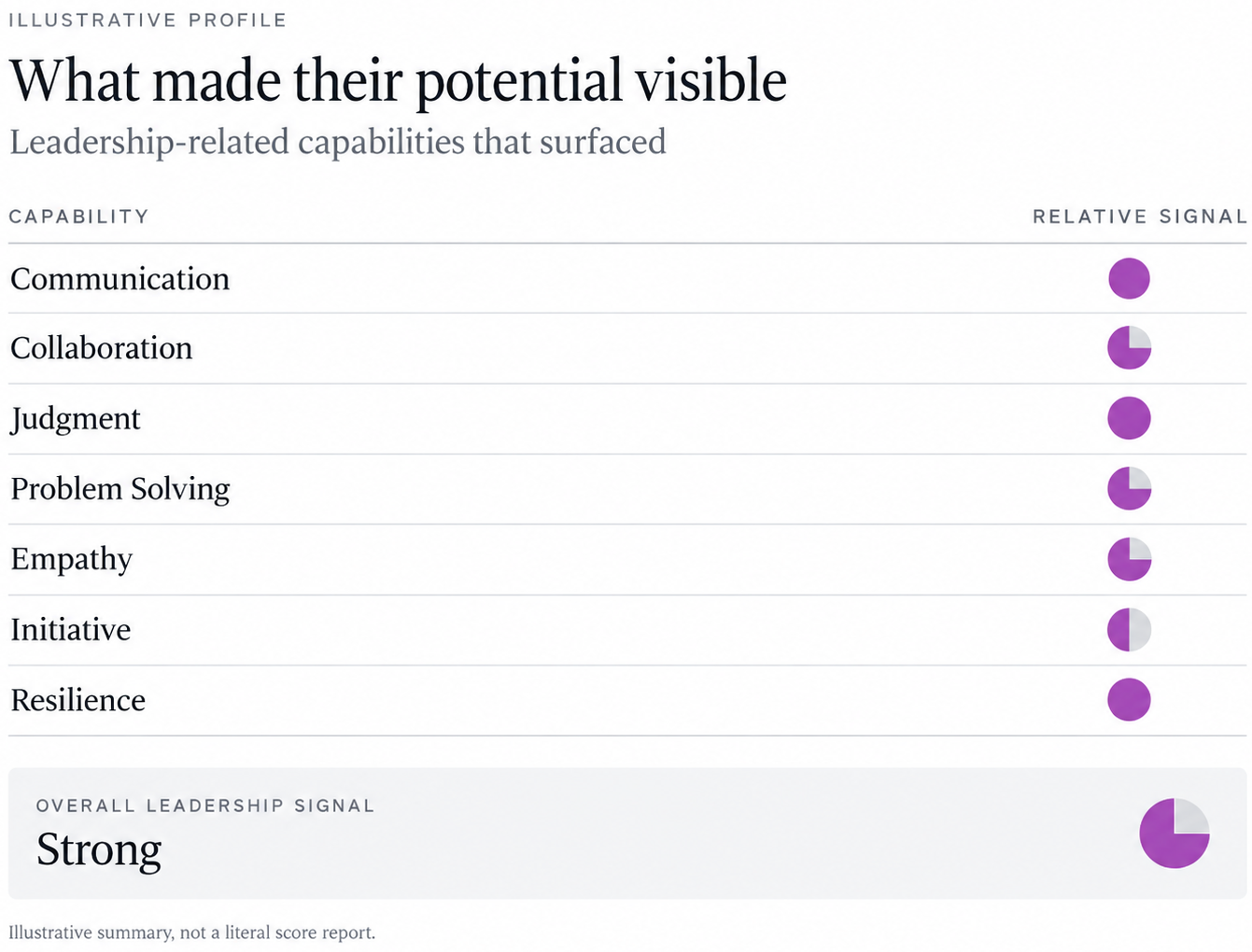
Maria and Angela’s leadership capabilities were hidden until the company actively sought to reveal them with MyInnerGenius.
Why hidden talent stays hidden
A degree, job title or career progression may suggest capability. It does not measure it.
These traditional signals can miss something even bigger: Capabilities developed through life experience.
People build capabilities like resilience, problem solving, and active listening through work, family responsibilities, setbacks, relationships, community, culture and countless everyday experiences that may never appear on a resume or transcript.
Without this full picture, we can’t make the best, unbiased decisions.
30 minutes changed the picture
The company used MyInnerGenius to assess human capabilities across thousands of employees.
The goal was to make durable, transferable capabilities visible, including the level at which they existed.
In less than 30 minutes, Maria and Angela surfaced as candidates with strong leadership potential.
The company interviewed both women to validate the leadership potential identified by MyInnerGenius. They were subsequently moved into leadership development.
Internal case documentation also reported increased self-confidence and agency, stronger commitment, greater engagement and renewed motivation to continue growing.
But the most important outcome may have been even simpler: The organization could finally see them.
Maria and Angela did not suddenly acquire leadership potential when they took an assessment.
They already had it. The data simply made it visible.
Their lives were forever changed. Their career trajectories changed. And the company identified two potential leaders who had been hiding in plain sight.
Who is walking through your front door?
The person walking through your front door may be looking for a job, choosing a career, trying to move up, starting over or simply looking for an opportunity.
Their resume, transcript, credentials or work history may tell you something about them.
But it tells you very little about what that person is actually capable of doing.
When capabilities remain invisible, people can be screened out, placed into the wrong roles, directed toward the wrong pathways or overlooked for opportunities they could thrive in.
The Takeaway:
→ Skills tell us what someone can do today.
→ Capabilities tell us what somebody can do tomorrow.
Once those capabilities are visible, better decisions become possible.
Somewhere in your organization, classroom, workforce center or community program, someone is capable of much more than their current circumstances suggest. Someone like Maria or Angela.
You may not have been able to see it. Now you can make it visible.
Wondering if you have a Maria or Angela whose potential is being overlooked? We can make it easy to find out. Email me at david@myinnergenius.com
About the Author:
David Leaser is an award-winning strategist, C-Suite consultant & program lead in L&D and HCM, Vice President at MyInnerGenius.. He is the founder of the IBM Digital Badge program, a leading-edge digital credential program, the IBM New Collar Certificate Program and IBM’s first cloud-based embedded learning solution. David was a senior strategist for IBM’s Smarter Workforce and the Global Skills Initiative. David is a Commissioner for The RSA (The royal society for arts, manufactures and commerce)'s Digital Badge Commission, a member of the 1Edtech Board advisory group for digital credentials, the national Credential As You Go Advisory Board and a senior advisor to New Markets Venture Capital Group. He provides guidance to the US Department of Labor and the US Department of Education as an employer subject matter expert.
David was appointed as an Industry Fellow in the Center for the Future of Higher Education & Talent Strategy in the College of Professional Studies at Northeastern University, an American Tier 1 university. He is the author of thought leadership white papers on talent development, including “Migrating Minds,” “The Social Imperative in Workforce Development” and Wiley’s “Connecting Workplace Learning and Academic Credentials via Digital Badges.”
David holds an M.A. in Communications Management from USC’s Annenberg School and a B.A. in Communications from Pepperdine University. Connect with David through LinkedIn.