
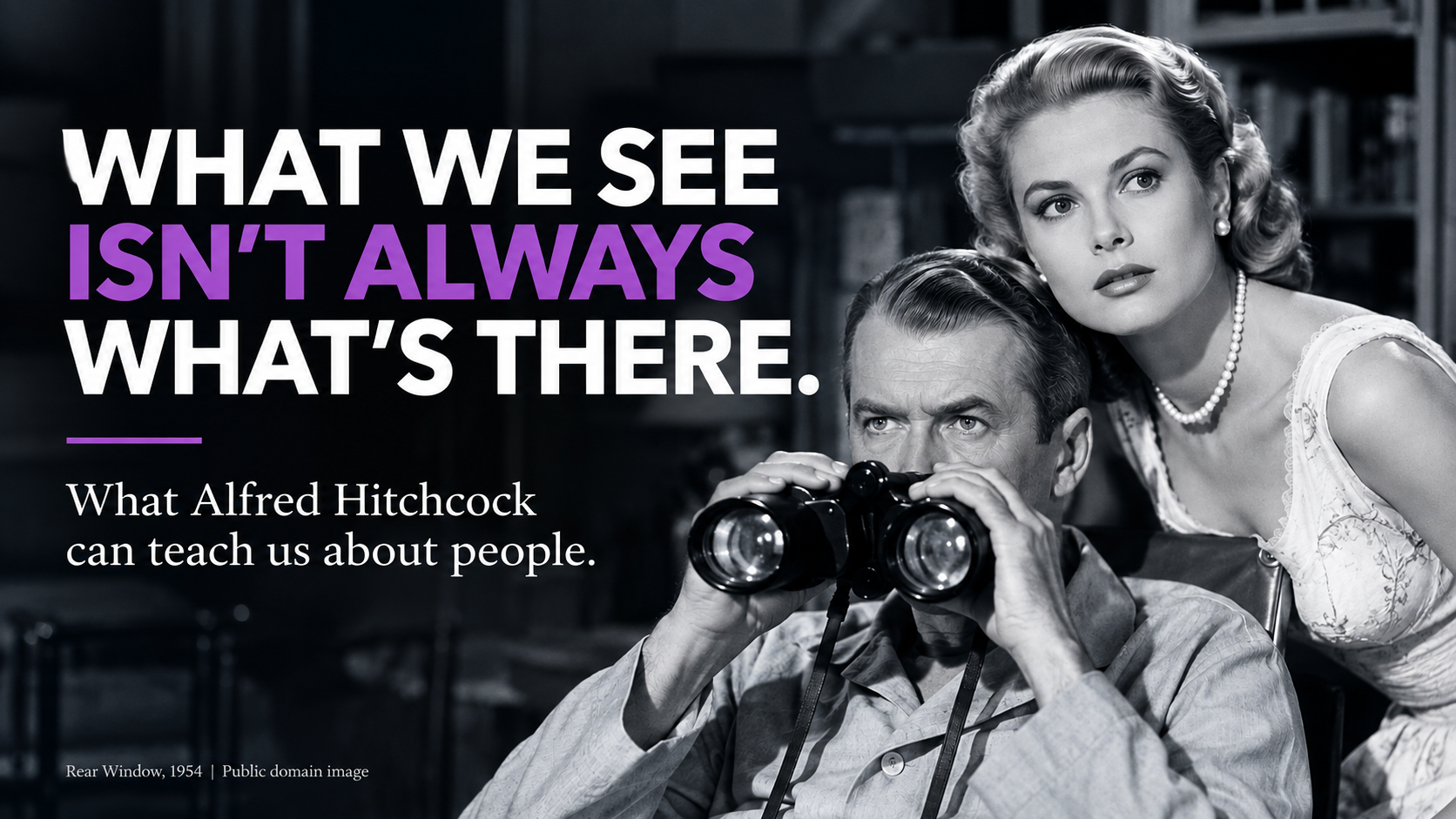
Four lessons from Rear Window about the people we think we know.
One of my favorite Alfred Hitchcock movies is Rear Window. I've seen it many times, but recently I started thinking about it very differently.
Not as a murder mystery, but as a story about how badly we can misjudge people.
And it made me wonder how often we make the same mistake when deciding who gets hired, promoted, educated, trained or given an opportunity.
We know a great deal about people's histories.
But how much do we really know about their capabilities?
In Rear Window, Jimmy Stewart plays Jeff, an adventurous photojournalist temporarily confined to a wheelchair. Grace Kelly plays Lisa, his sophisticated girlfriend who seems completely at home in a world of fashion, elegant restaurants and New York society.
Jeff is convinced they're fundamentally incompatible.
He travels the world. She attends fashion shows. He takes risks. She wears couture.
From everything he can see, Jeff thinks he knows exactly who Lisa is and, more importantly, what she is capable of.
He is spectacularly wrong.
As the mystery unfolds, Lisa begins displaying qualities Jeff apparently never knew she possessed. She's curious, resourceful, creative, adaptable and courageous. She exercises judgment, solves problems and is willing to take considerably more risk than Jeff ever imagined.
Eventually, Lisa climbs a fire escape, enters the suspected murderer's apartment and searches for evidence while Jeff, the supposedly fearless adventurer, can do nothing but watch from his wheelchair.
That scene got me thinking about something much bigger than the movie. And we make essentially the same mistake with people every day:
Lisa didn't suddenly acquire those capabilities. They were there all along. Jeff simply couldn't see them.
Four lessons Hitchcock can teach us about people
1. Why do we mistake what we see for who someone is?
An employer sees a résumé, degree and employment history. A college sees grades and a transcript. A workforce counselor sees education, work experience and barriers to employment. A community organization may see someone's circumstances and the obstacles standing in their way.
All of that information matters. But none of it gives us a complete picture of the person.
The problem isn't that we consider these things. It's that we become too confident about what they tell us.
We mistake what is visible for the whole person.
2. Does someone's past tell us what they're capable of doing next?
A frontline employee may possess many of the underlying capabilities of your best manager.
A student with average grades may be extraordinarily innovative.
A job seeker with an inconsistent employment history may possess the cognitive and behavioral capabilities to excel in an entirely different occupation.
And someone who has spent years being defined by barriers may have strengths that no résumé, transcript or application has ever captured. That's what Jeff discovered about Lisa. The capabilities were already there. She simply hadn't had the opportunity to demonstrate them in a way he could recognize.
A person’s history tells us where they've been. It doesn't tell us where they can go.
3. How do our assumptions cause us to overlook potential?
We infer capability from education, potential from experience, intelligence from grades. leadership ability from previous job titles and future performance from past opportunity.
And now we're asking AI to make inferences from much of that same information.
But inference doesn't necessarily produce a complete understanding of a person.
Then we make enormous decisions based on those assumptions: who gets hired, who gets promoted, which student gets encouraged toward which pathway, who receives an opportunity and who gets overlooked.
Sometimes our assumptions are right. And sometimes we're Jeff looking at Lisa and deciding that because she knows haute couture, she couldn't possibly handle an adventure.
4. How much human potential are we overlooking?
This may be the biggest lesson for me.
We have more data about people than ever before. Résumés. Transcripts. Credentials. Degrees. Job histories. Performance reviews. Skills profiles.
But most of that information tells us what people have done. It tells us considerably less about what they may be capable of doing next.
That becomes even more important as AI changes work. Technical skills and AI fluency are becoming "table stakes." Critical thinking, judgment, communication, collaboration, adaptability, creativity and problem solving are now the differentiators.
Many of those capabilities are difficult to see from the traditional signals we rely upon.
The next great leader may be answering customer calls. The greatest innovator may be working in operations. A student struggling to find direction may possess extraordinary strengths nobody can see.
Sometimes the capability isn't missing. It's simply invisible.
We need a better way to see people
This is a problem we spend a lot of time thinking about at MyInnerGenius: How do we make more of the person visible before we make decisions about their future?
Scientifically validated assessments provide another lens by helping identify underlying capabilities, behavioral characteristics, interests and motivations that traditional signals may miss.
Not to replace résumés, transcripts, credentials or experience. To reveal something they often cannot.
And whether you're hiring employees, guiding students, helping people find meaningful work or developing future leaders, I think Hitchcock gives us four questions worth asking:
Are we looking beyond the surface? What assumptions are we making based on someone's education, experience, grades or circumstances?
Do we actually understand their capabilities? Have we measured what matters, or are we relying on assumptions and inference?
Are we confusing experience with potential? Could this person succeed in a role or pathway they haven't previously had an opportunity to pursue?
What opportunities might we be overlooking? How would a better understanding of this person's strengths and capabilities change our decisions?
These questions aren't simply about making better hiring decisions. They're about helping people discover opportunities they may never have imagined for themselves.
The person right in front of us
There is a wonderful irony in Rear Window. Jeff spends most of the movie studying other people and drawing conclusions about their lives from the fragments he can see.
But one of the people he understands least is sitting right beside him. Lisa.
There's a lesson in that for all of us.
If we only look at the surface, we miss what's hiding in plain sight.
The employee.
The student.
The job seeker.
The person whose circumstances have obscured their potential.
Their capabilities may already be there. The question is whether we know how to see them.
What might you be missing?
At MyInnerGenius, we're helping organizations see capabilities, strengths and potential that traditional measures often overlook. And I'd love to show you how we do it.
In just a few minutes, I can demonstrate how you can uncover insights about people that may never appear on a résumé, transcript or job title -- and how those insights can lead to better decisions.
Email me directly at david@myinnergenius.com and let's make the invisible visible.
About the Author:
David Leaser is an award-winning strategist, C-Suite consultant & program lead in L&D and HCM, Vice President at MyInnerGenius.. He is the founder of the IBM Digital Badge program, a leading-edge digital credential program, the IBM New Collar Certificate Program and IBM’s first cloud-based embedded learning solution. David was a senior strategist for IBM’s Smarter Workforce and the Global Skills Initiative. David is a Commissioner for The RSA (The royal society for arts, manufactures and commerce)'s Digital Badge Commission, a member of the 1Edtech Board advisory group for digital credentials, the national Credential As You Go Advisory Board and a senior advisor to New Markets Venture Capital Group. He provides guidance to the US Department of Labor and the US Department of Education as an employer subject matter expert.
David was appointed as an Industry Fellow in the Center for the Future of Higher Education & Talent Strategy in the College of Professional Studies at Northeastern University, an American Tier 1 university. He is the author of thought leadership white papers on talent development, including “Migrating Minds,” “The Social Imperative in Workforce Development” and Wiley’s “Connecting Workplace Learning and Academic Credentials via Digital Badges.”
David holds an M.A. in Communications Management from USC’s Annenberg School and a B.A. in Communications from Pepperdine University. Connect with David through LinkedIn.