
Why AI transformations fail: The missing layer of human capability
92% of talent professionals say soft skills matter as much as or more than hard skills.
LinkedIn published that finding years before generative AI entered the workplace. I think the point matters even more now. LinkedIn's 2019 Global Talent Trends research found that 30% of talent professionals prioritized soft skills and another 62% considered soft and hard skills equally important.
I also think “soft skills” is the wrong term.
There is nothing soft about critical thinking, judgment, adaptability, communication, problem solving or decision-making. These are durable, transferable human capabilities, and they increasingly determine whether people can turn technology into results.
That distinction became the centerpiece of a presentation I gave at TechLearn 2026 in Austin.
AI fluency is not AI effectiveness
We are putting enormous energy into AI literacy and fluency. That's necessary. People need to understand the tools, know how to prompt them and learn where AI can improve their work.
But that's only the starting point.
→ AI fluency tells us whether someone knows how to use AI.
→ AI effectiveness tells us whether they can, and will, use it wisely.
Can they recognize when an AI-generated answer is wrong? Can they challenge an assumption? Can they decide what should be automated and what still requires human judgment? Can they communicate a recommendation, work through ambiguity, adapt when circumstances change and take responsibility for the outcome?
Those aren't primarily technology questions. They're human capability questions.
This also helps explain why buying more AI tools is not, by itself, a transformation strategy. BCG's 10-20-70 framework puts roughly 70% of AI transformation effort into people and processes, 20% into technology and data and 10% into algorithms.
The capability gap is already here
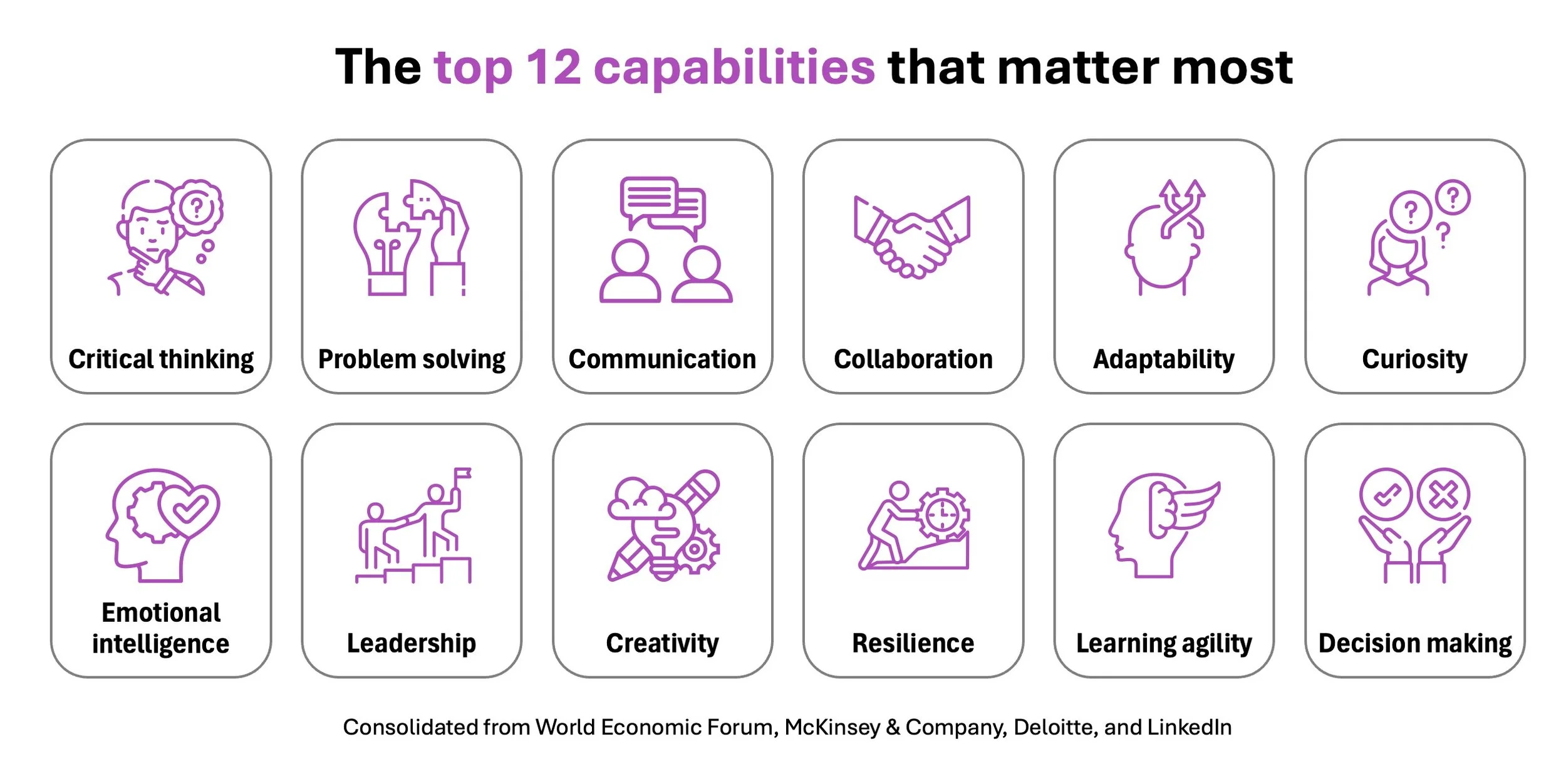
Multiple major studies—including the World Economic Forum, McKinsey & Company, Deloitte, and LinkedIn—continue pointing toward remarkably similar human capabilities.
The problem isn't that organizations think capabilities are unimportant. The problem is that many don't have a systematic way to identify and build them.
The Josh Bersin Company found that only 27% of companies believe they are effectively building the skills and capabilities needed to support their business strategy. In other words, nearly three quarters do not.
At the same time, we continue to see many of the same human capabilities surface across workforce research:
Critical thinking. Problem solving. Communication. Collaboration. Adaptability. Curiosity. Emotional intelligence. Leadership. Creativity. Resilience. Learning agility. Decision-making.
We know these capabilities matter. What we often don't know is where they already exist in the workforce.
The visibility problem
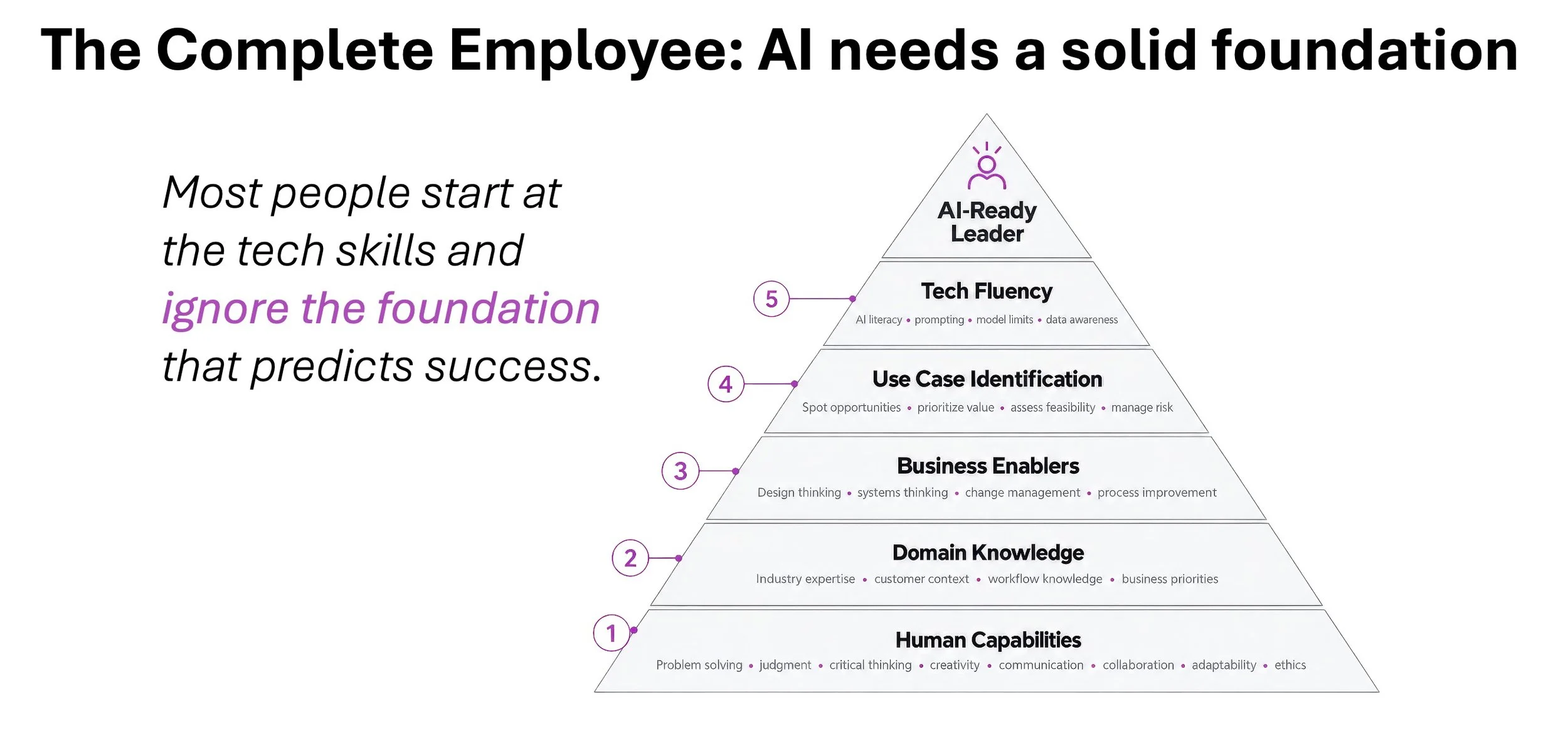
When you are developing a student, client or employee, start at the bottom.
Most organizations have plenty of data about employees. They know job titles, tenure, degrees, certifications, training completions, performance ratings and work history.
→ But much of that data tells us what someone did.
→ It doesn't necessarily tell us what someone can do.
A person may have extraordinary problem-solving ability that has never been required in the current job. Someone may have developed resilience, empathy, leadership or judgment through life experiences that never appear on a résumé.
Another employee may be highly successful in a role they don't even enjoy and may have capabilities that make them far better suited for something else.
This is why I believe the next evolution of talent intelligence has to go deeper.
We need to understand the complete person, not simply the visible record of their employment.
Knowing what someone did is becoming less important than knowing what they can do.
Build a Capability Intelligence practice
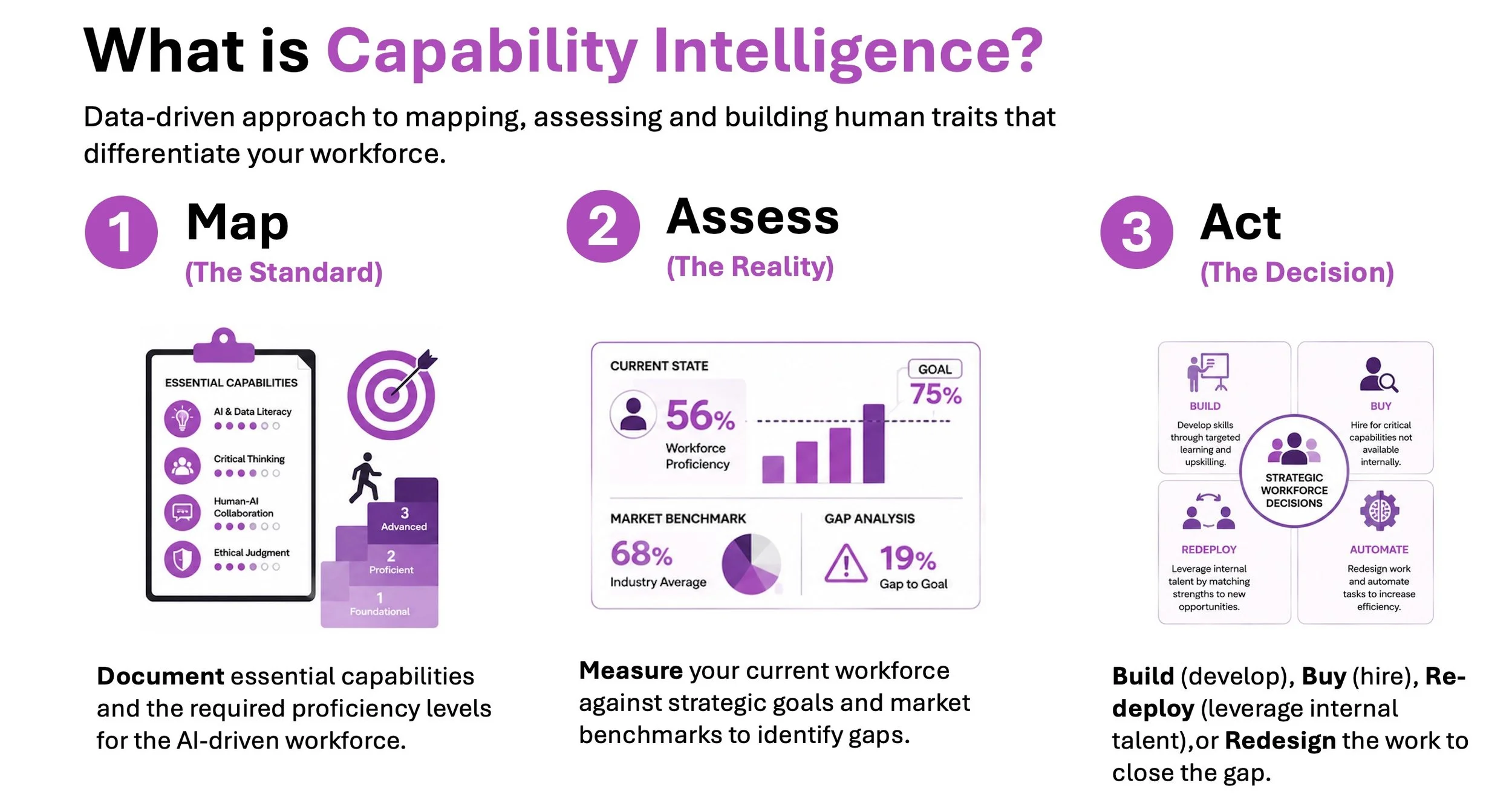
Knowing what someone can do requires a more deliberate discipline. I call it Capability Intelligence: a data-driven approach to understanding the human capabilities the organization needs, what already exists in the workforce and what to do about the gaps.
The model is simple:
MAP. Define the capabilities the work requires and the proficiency levels that matter.
ASSESS. Objectively identify the capabilities people already have and where the gaps exist.
ACT. Decide whether the right response is to build, buy (hire), redeploy or redesign and automate the work.
Not every capability gap is a training problem.
Sometimes the capability already exists somewhere else in the organization. Sometimes the better answer is internal mobility. Sometimes it's hiring. Sometimes the work itself should be redesigned around what AI can do better.
Training should come after those decisions, not before them. And when development is the answer, courses alone aren't enough.
Capabilities are built through experience
You don't develop judgment by watching a video about judgment.
You build it by making decisions, seeing the consequences, getting feedback, reflecting and trying again.
The same is true for critical thinking, problem solving, communication, collaboration and leadership.
That means moving from traditional learning paths toward capability pathways that combine scenarios, simulations, projects, peers, managers, reflection, training and opportunities to demonstrate the capability in action.
Training still matters. It provides knowledge, frameworks and techniques. But content consumption is not capability development.
The new mission of L&D
AI can now generate enormous amounts of knowledge in seconds. That should force us to reconsider what Learning & Development is ultimately trying to accomplish.
The mission can't simply be helping people know more.
It has to be helping people become more capable.
That means making human capabilities visible. Measuring them. Developing them intentionally. Connecting them to the work the organization needs done. And measuring whether those capabilities actually change behavior and business results.
AI is going to keep getting better at tasks. That doesn't make human capability less important.
It makes understanding and developing it more important.
The organizations that create value from AI won't simply be the ones with the best technology. They'll be the ones that understand what their people bring to the partnership, where the gaps exist and how to build the capabilities technology alone cannot supply.
Your turn
I explored this framework at TechLearn 2026 in Austin. If you'd like a copy of the presentation, send me a message. I'll also send you our Human Capability Playbook, which goes deeper into how to put a Capability Intelligence practice into action.
About the Author:
David Leaser is an award-winning strategist, C-Suite consultant & program lead in L&D and HCM, Vice President at MyInnerGenius. He is the founder of the IBM Digital Badge program, a leading-edge digital credential program, the IBM New Collar Certificate Program and IBM’s first cloud-based embedded learning solution. David was a senior strategist for IBM’s Smarter Workforce and the Global Skills Initiative. David is a Commissioner for The RSA’s (The royal society for arts, manufactures and commerce) Digital Badge Commission, a member of the 1Edtech Board advisory group for digital credentials, the national Credential As You Go Advisory Board and a senior advisor to New Markets Venture Capital Group. He provides guidance to the US Department of Labor and the US Department of Education as an employer subject matter expert.
David was appointed as an Industry Fellow in the Center for the Future of Higher Education & Talent Strategy in the College of Professional Studies at Northeastern University, an American Tier 1 university. He is the author of thought leadership white papers on talent development, including “Migrating Minds,” “The Social Imperative in Workforce Development” and Wiley’s “Connecting Workplace Learning and Academic Credentials via Digital Badges.”
David holds an M.A. in Communications Management from USC’s Annenberg School and a B.A. in Communications from Pepperdine University. Connect with David through LinkedIn.